A Blockchain is a distributed (write-once) database that represents the equivalent of a distributed and redundant registry among all participants. Here we must understand the term register in its ancestral sense: a collection of transactions, a book of operations.
In the physical world, a register is centralized and held by a single entity. The "revolutionary" side of the Blockchain lies in the fully distributed aspect of the register and in the absence of a centralizing authority to validate transactions (we speak of trustless model or organization without single manager). The security of the registry and transactions is here ensured by cryptography.
The use of Blockchains is not limited to electronic money only (crypto-currencies) and extends to all forms of contracts or transactions. The concept can potentially revolutionize all forms of transactions in an all-digital world, be it exchanging goods, values, digital private data, or services.
Blockchain-as-a-Service
The implementation of a complete and extensive Blockchain system is not just a technical problem. It is a challenge that consists above all in setting up a complete ecosystem with its application developers, its users (transmitters and receivers), its "miners", its processors (for example payment in the context of a currency ), etc.
However, the technical implementation is in itself a real challenge. Hence the idea of simplifying it through cloud services. Thus was born one of the first BaaS (Blockchain as a Service) market: Azure
The implementation of a complete and extensive Blockchain system is not just a technical problem. It is a challenge that consists above all in setting up a complete ecosystem with its application developers, its users (transmitters and receivers), its "miners", its processors (for example payment in the context of a currency ), etc.
However, the technical implementation is in itself a real challenge. Hence the idea of simplifying it through cloud services. Thus was born one of the first BaaS (Blockchain as a Service) market: Azure
Blockchain.
The service aims at both:
The service aims at both:
accelerate technical implementations;
accelerate the development of applications that take advantage of it (by reducing the technical entry ticket to master concepts and providing complementary middleware tools and services);
promote the development of an ecosystem (notably through the Marketplace).
Basically, Azure Blockchain-as-a-Service has two main components:
promote the development of an ecosystem (notably through the Marketplace).
Basically, Azure Blockchain-as-a-Service has two main components:
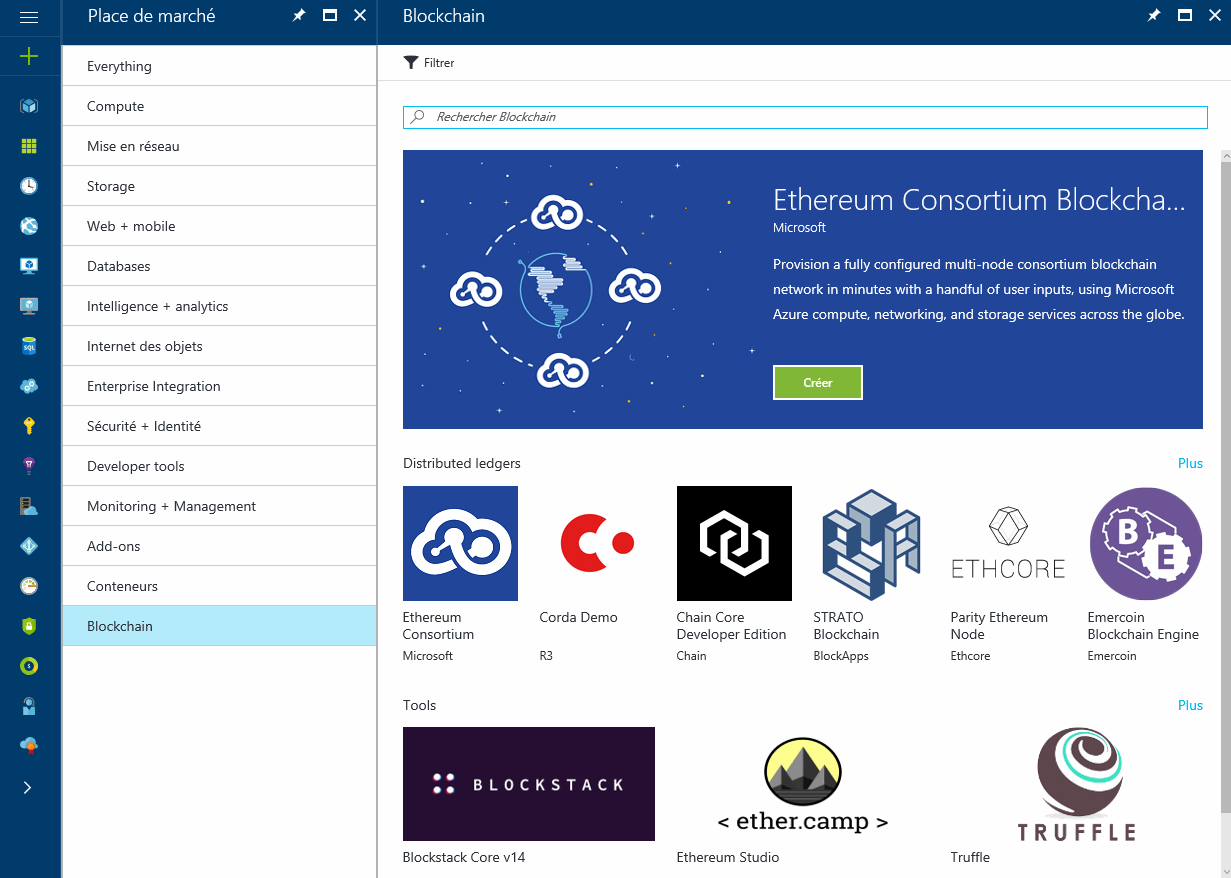
The first is for companies that want to experiment Blockchain applications with "out of the box" solutions. The Azure Marketplace offers a whole catalog of such solutions.
The second is for developers by offering Dev Tests Labs and a set of services and tools (in the cloud or integrated with Visual Studio) to accelerate the development of "smart contracts" and applications based on n any Blockchain technology. For example, the Solidity language (the most popular language for developing Ethereum Smart Contracts) is available in Visual Studio.
Stay open
The primary purpose of Azure Blockchain is to provide one-click provisioning of a Blockchain experiment environment (using predefined templates) to create Blockchains very quickly (whether public or private) and to develop complete solutions. .
Microsoft sees its service as a sandbox where everyone can come to experiment but also as an effective way to expose BaaS solutions worldwide on its Azure platform.
Stay open
The primary purpose of Azure Blockchain is to provide one-click provisioning of a Blockchain experiment environment (using predefined templates) to create Blockchains very quickly (whether public or private) and to develop complete solutions. .
Microsoft sees its service as a sandbox where everyone can come to experiment but also as an effective way to expose BaaS solutions worldwide on its Azure platform.
Contrary to popular belief, the publisher's goal is not to eventually create its own protocol but to allow market players (typically banks and players like KPMG, Accenture, E & Y) to apply the technologies. Blockchains of their choice to the case of trades uses.
Moreover, unlike IBM, whose BaaS service relies entirely on Hyperledger (supported by the Linux foundation), Microsoft multiplies partnerships: Alphapoint, Augur, BigChaindb, BitPay, BitShares, CoinPrims, Emercoin, Ethereum, Eris, Flacom, Hyperledger, LibraTsx, Lisk, Manifold, Ripple, Slock.it, Stori, Strato, Syscoin, Tendermint, all and many more are available on Azure and on its Marketplace.
Bletchley Project
However, the publisher intends to bring his own technologies and bricks to the building and bring value add to Azure Blockchain-as-a-Service.
Witness the Bletchley project launched last fall. It can be seen as a modular and open platform that combines all kinds of technologies to build business solutions more easily and quickly using the main blockchains on the market.
Bletchley also provides a general framework defining an evolution of Blockchains 3.0 (Bitcoin being considered evolution 1, and Smart Contracts based protocols as evolution 2).
It focuses however on the idea of blockchains related to consortia.
The Bletchley architecture proposes evolutions to enrich the SmartContracts and brings together a certain number of key services essential to the realization of complete solutions above Blockchains. In other words, Bletchley is also a set of middleware services located between the underlying Blockchain platform and business solutions.
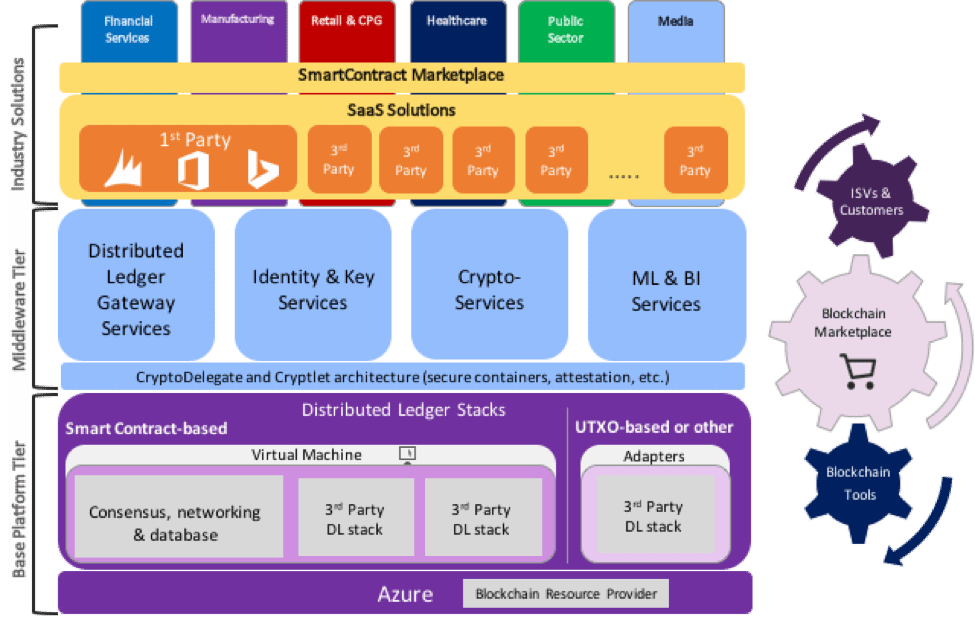
These key middlewares services include gateway services to enable inter-blockchain communications, identification and key management services (to manage access rights to the private blockchain), encryption services, security services, and encryption services. data (analytics, machine learning, cognitive, audits), and a Cryplet Fabric.
Cryptlets (and the accompanying Cryplet Fabric) are Bletchley's main innovation and add to the functionality and potential of Smart Contracts. They are a safer, more standardized and more formalized alternative to Ethereum's oracles. In the Blockchain 2.0 spirit, whenever time events or external conditions must interact with the Blockchain, an "oracle", ie a set of "data + codes" outside the Blockchain, must be called.
The problem: these oracles have no formalization (which complicates multi-party scenarios) and raise many questions about trust and security. Hosted in the Azure Cloud, Cryplets offer a much more formalized alternative in the form of programmable components in any language and run in a trusted and secure cloud environment. It is also via the Cryplets that SmartContracts can interact with the Azures services provided by the Bletchley platform.
In its first release, Bletchley becomes Azure in the form of a Blockchain consortium model that allows a company to mount a private Ethereum network running from a few nodes to several hundred nodes. Implementing such a multi-node distributed network would likely take 3 weeks normally. It suffices here to inform the 8 questions of the assistant and the infrastructure is in place after 5 minutes with the provision of a specific portal to quickly start the development of Cryplets and applications on Ethereum.
However, as we have already said, neither Bletchey nor the Cryplets are intimately related to Ethereum. Other "templates" should appear in the months to come.
Moreover, unlike IBM, whose BaaS service relies entirely on Hyperledger (supported by the Linux foundation), Microsoft multiplies partnerships: Alphapoint, Augur, BigChaindb, BitPay, BitShares, CoinPrims, Emercoin, Ethereum, Eris, Flacom, Hyperledger, LibraTsx, Lisk, Manifold, Ripple, Slock.it, Stori, Strato, Syscoin, Tendermint, all and many more are available on Azure and on its Marketplace.
However, the publisher intends to bring his own technologies and bricks to the building and bring value add to Azure Blockchain-as-a-Service.
Witness the Bletchley project launched last fall. It can be seen as a modular and open platform that combines all kinds of technologies to build business solutions more easily and quickly using the main blockchains on the market.
Bletchley also provides a general framework defining an evolution of Blockchains 3.0 (Bitcoin being considered evolution 1, and Smart Contracts based protocols as evolution 2).
It focuses however on the idea of blockchains related to consortia.
The Bletchley architecture proposes evolutions to enrich the SmartContracts and brings together a certain number of key services essential to the realization of complete solutions above Blockchains. In other words, Bletchley is also a set of middleware services located between the underlying Blockchain platform and business solutions.
These key middlewares services include gateway services to enable inter-blockchain communications, identification and key management services (to manage access rights to the private blockchain), encryption services, security services, and encryption services. data (analytics, machine learning, cognitive, audits), and a Cryplet Fabric.
Cryptlets (and the accompanying Cryplet Fabric) are Bletchley's main innovation and add to the functionality and potential of Smart Contracts. They are a safer, more standardized and more formalized alternative to Ethereum's oracles. In the Blockchain 2.0 spirit, whenever time events or external conditions must interact with the Blockchain, an "oracle", ie a set of "data + codes" outside the Blockchain, must be called.
The problem: these oracles have no formalization (which complicates multi-party scenarios) and raise many questions about trust and security. Hosted in the Azure Cloud, Cryplets offer a much more formalized alternative in the form of programmable components in any language and run in a trusted and secure cloud environment. It is also via the Cryplets that SmartContracts can interact with the Azures services provided by the Bletchley platform.
In its first release, Bletchley becomes Azure in the form of a Blockchain consortium model that allows a company to mount a private Ethereum network running from a few nodes to several hundred nodes. Implementing such a multi-node distributed network would likely take 3 weeks normally. It suffices here to inform the 8 questions of the assistant and the infrastructure is in place after 5 minutes with the provision of a specific portal to quickly start the development of Cryplets and applications on Ethereum.
However, as we have already said, neither Bletchey nor the Cryplets are intimately related to Ethereum. Other "templates" should appear in the months to come.
0 Comments
Post a Comment